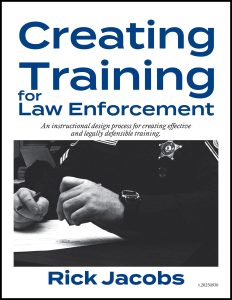

Creating Training for Law Enforcement
Creating Training for Law Enforcement provides a process for creating training that is based on decades of learning science and instructional design processes, but customized for the restrictions and needs of law enforcement. For instance, civilian organizations do not have to worry about direct and vicarious liability with every interaction and employee. Also, civilian organizational training does not have case law and precedence dictating what needs to be in training is rarely ever challenged in court.
The foundational principle of this book is creating a process that documents every step of creating training, what I call creating a “training chain of evidence.” Courts and attorneys are starting to attack training design and function, as well as attacking the instructors who write it using their “background, training, and experience.” The days of “background, training, and experience” are over in the face of a science and research based learning industry. Instead, training needs to be based on “research, observation, and analysis.”
This process provides you the tools, documents, and templates, with explanations and tasking to use them. Every step of the process creates a piece of evidence of “why” the course delivers and assesses participant performance the way it does.
This is not a book on learning theories, tactics, or how people learn – there are plenty of books that already cover this. Instead, it provides a process, quality assurance methodology, and rigor that makes your training defensible if it comes to court, what we were not taught in instructor courses.
Law enforcement instructors are rarely taught more than “create an outline, objectives, slide decks, and a test.” This is one of the reasons that LE training is not as effective as it should be. Until instructors are trained on how to create training, true change and reform cannot occur, and we really need it to.
485 pages of:
-
- A process for creating defensible training using established and researched frameworks, methods, and concepts, and theories put to practice
- Design and evaluation methods for measuring performance – of the course and the participants through time.
- Templates, documents, examples, and activities to build a course while working through the book.
- Options for maximizing your learning experience with free access to videos, links for creating a class, and the ability to get a certificate of completion by completing tasks and receiving feedback.
$64.95 for the paperback
$ 44.95 for the electronic version
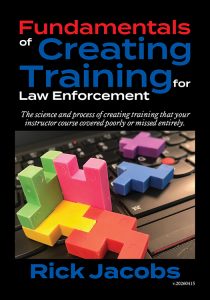
Fundamentals of Creating Training for Law Enforcement
If you’re still doing what you learned in your instructor basic class, you’re most likely creating training wrong or at least missing a lot of important parts.
Fundamentals of Creating Training for LE should be the textbook for instructor basic courses when it comes to the course design portion. Most instructor basic classes cover only what is necessary to meet minimum POST requirements for documenting training, and most do even that poorly.
This book aligns the basics with instructional design standards. You’re already doing a lot of this, but now you can do it to a higher standard that is based on learning science and instructional design research.
This book also fills some of the gaps missing in instructor basic courses, provides processes most didn’t know existed, and lifts the quality of training documentation closer to a “learning chain of evidence.”
This book covers:
- Using ADDIE with processes that create a “learning chain of evidence.”
- Writing objectives that actually measure performance.
- Bloom’s Taxonomy the way it was meant to be used, to include the missing domains.
- Creating course materials that support consistency, continuity and real accountability.
- Designing and writing scenarios that measure performance instead of results.
- Creating reliable, valid, and sound assessments that measure more than “Remembering.”
- Writing End of Course Surveys that provide actionable results.
- And a lot more!
This is the middle step between the little we get in class and the advanced, step-by-step process you get in Creating Training for Law Enforcement.
$44.95 for the paperback
$ 29.95 for the electronic version