
• Home
  • Services
    • List of services
    • Course Review
    • Training Evaluation Program
    • LMS & Web Hosting
  • Training
    • Online
    • Instructor led
      • Fundamentals of Creating Training
      • Designing Training for Law Enforcement
      • Creating Training for Law Enforcement
      • Basic Law Enforcement Instructor Certification Course
      • Classroom Command for Law Enforcement Instructors
  • Books
  • Samples
    • V/ILT
    • eLearning
    • Scenario
    • Motion
    • Process
  • Articles
  • Contact
  • About
  • Shop
  • »
  • »
  • »
$0.00
No products in the cart
Go to shop
LETnECLETnEC
LETnECLETnEC
Training and Development strategy, products,
and services for law enforcement.
  • Home
  • Services
    • List of services
    • Course Review
    • Training Evaluation Program
    • LMS & Web Hosting
  • Training
    • Online
    • Instructor led
      • Fundamentals of Creating Training
      • Designing Training for Law Enforcement
      • Creating Training for Law Enforcement
      • Basic Law Enforcement Instructor Certification Course
      • Classroom Command for Law Enforcement Instructors
  • Books
  • Samples
    • V/ILT
    • eLearning
    • Scenario
    • Motion
    • Process
  • Articles
  • Contact
  • About
  • Shop
  • »
  • »
  • »

eLearning

eLearning design, development, and strategy

eLearning is a difficult type of training for law enforcement to get behind, primarily for one reason: most of it is designed very poorly.

eLearning is more than the tool used to build the courses – eLearning is a category of learning that requires a very different set of solutions than instructor-led training. It requires a very different level of design and planning, as well as understanding the limitations that will impact expectations.

eLearning has a place and needs to be planned around its shortcomings. eLearning can be anything delivered electronically, it isn’t always an interactive video or slide deck. eLearnign is only effective if you have someone who understands learning theory and performance improvement concepts. Unfortunately, most eLearning products are created by people with one skill set – they know how to use the tools.

eLearning is great for education and for training digital-based skills, but it should be designed so that the parts where it fails are mitigated, even if that means making the training hybrid, which is the combination of eLearning and ILT. It requires strategy and someone who understands how law enforcement are trained, but also the case law that supports training concepts in law enforcement.

While eLearning is not the tool used, we are very proficient in Articulate Storyline, Rise, and Adobe Captivate. We also use other technology for creating animations, videos, and shoot a lot of our own imagery.
Learning Management Systems (LMS)

Part of any learning strategy has to include consideration for how to deploy your training. We provide LMS options for agencies through Miravoy.com. We offer either hosting solutions through Moodle installations or by providing exclusive pricing solutions for MyQuest.co.

HnRSceneScreenShot

Holds and Restraints Refresher

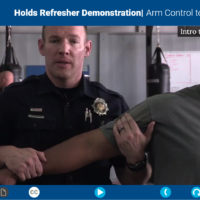
How do you provide a refresher training in something that most commonly requires hands-on experience? When faced with this question of providing an online refresher in defensive tactics, this was the primary hurdle.

You get creative and provide caveats, and make it a hybrid course.

We created this training reinforcing the idea of breaking these complex, motor manipulation skills into smaller components:
1. demonstrate in real time
2. break down each step
3.  review with another demonstration to pull the parts together.

We also provided the caveats that, first, this training was only for those who had already passed an agency approved defensive tactics course and, second, the best training is hands-on and participants should practice with a certified instructor. Third, the online portion only counts for three of the four hours. In order to get full credit, they have to meet with an agency approved DT instructor to demonstrate their skills for the final hour.

Assessing Holds and Restraints Refresher

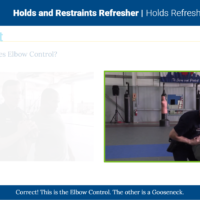
The next big question is how do you measure knowledge transfer for something that would commonly be performed. The standard 10-question, multiple-guess quiz wouldn’t be sufficient, and would be pretty much useless in this case.

Since they cannot perform the tactics as part of their training, they could identify the correct methods, if they paid attention.

Assessing in eLearning is only limited by the creativity of the designer. In this case, we used the same technique as the training itself – they had to identify the correct procedures or steps from watching videos or by arranging the steps in the correct order.

AssessScreenShot
U0FScreenShot

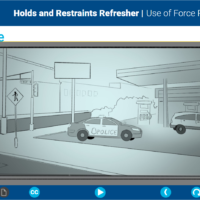
Use of Force Refresher

Use of Force is best trained through scenarios. You can read the law and the opinions, but having a scenario to relate to is a better experience. However, creating a video of a scenario is expensive, logistically difficult, and you never know the quality you will get from the “actors.”

Lexipol has a monthly DTB they send out with a scenario, a question about the scenario, then supporting content. We used the questions as part of the pre-test for the training, then used their scenarios to create graphic illustrations with voice overs.

The result is introducing the participant to the content through a scenario in a creative way to get them thinking, offer the question, then present the material.

Investing in training is investing in your people and your organization.

It is also more than just telling people what to do, it is empowering them to know why and how best to accomplish what you ask them to do.

Contact us today for a free consultation! Contact us

© 2026 — LETnEC, a division of Jacobs, et al, LLC | Privacy Policy | Website hosted and designed by Miravoy.com: hosting for law enforcement and learning.

Press Enter to search · Esc to close

Creating Training for Law Enforcement now available! Dismiss